Art11 October 2026 · 2 min
Franz Marc went off animals
A major exhibition in Düsseldorf shows the painter of the blue horses as something less comfortable than the posters suggest.
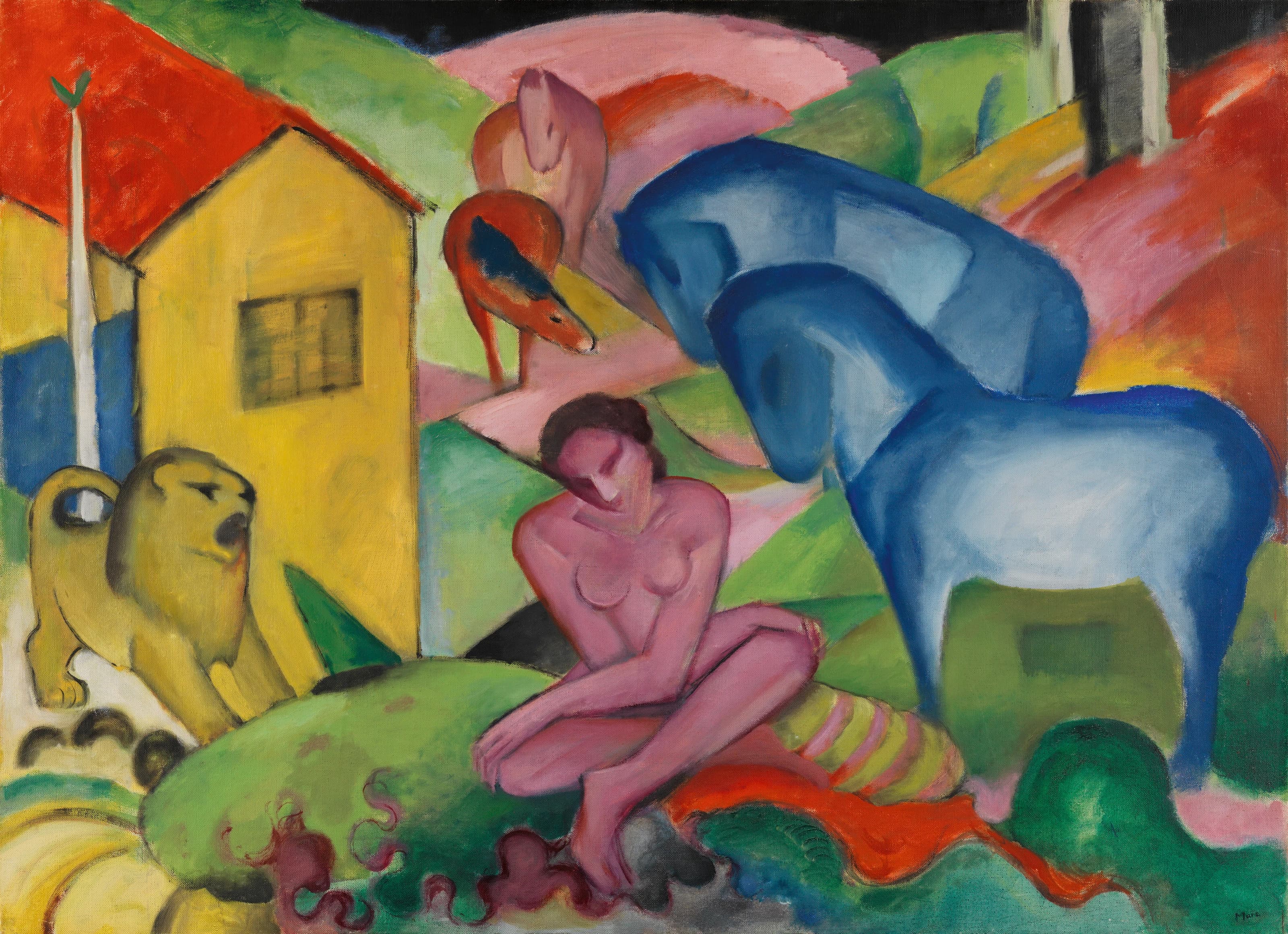
Der Traum, 1912. Photo: Achim Kukulies
Franz Marc is the painter of the blue horses. If you know one thing about him, that is it: bright animals at peace in bright landscapes. A large exhibition at K20 in Düsseldorf, the first major one in a German museum in more than twenty years, gathers over 120 works. Read carefully, it tells a less cosy story.
He did love animals, and he had a theory about it. Marc thought modern, mechanised life was shallow, and that animals had kept something people had lost. He wanted to paint them as they see the world, not as we see them. He even gave the colours moral jobs. Blue was male and spiritual, yellow female and gentle, and red was brute matter that the other two had to defeat.
It did not last. In the spring of 1913, after a trip to South Tyrol, the horses in his pictures turn thin and miserable. A year later he is painting pure shapes, with titles such as Fighting Forms and Broken Forms.
He explained why afterwards. Even in animals, he wrote, he had found "so much that was emotionally objectionable and so ugly" that his pictures became more and more abstract. Art history tends to treat abstraction as a breakthrough. For Marc it reads more like a disappointment.
Then came the war. Marc began military service on 6 August 1914 and, like many artists of his generation, at first believed the war was necessary. His closest friend, the painter August Macke, was killed within weeks. Marc wrote more than 350 letters home to his wife Maria.
On the morning of 4 March 1916, near Verdun, he wrote to her that he would be home that year. He was killed by shrapnel the same day. He was on reconnaissance, on horseback.
The exhibition is called The Quest for a Better World, and the programme around it leans toward the gentler Marc. There is forest bathing, and a talk on the horse girl as a figure in youth culture. The audio guide is the sharper choice. It is narrated by Felix Kammerer, who played the young soldier in All Quiet on the Western Front.
The exhibition runs at K20 until 24 January 2027.